




https://jiji.ng/sellerpage-577707
Kwon Hyuk-chul
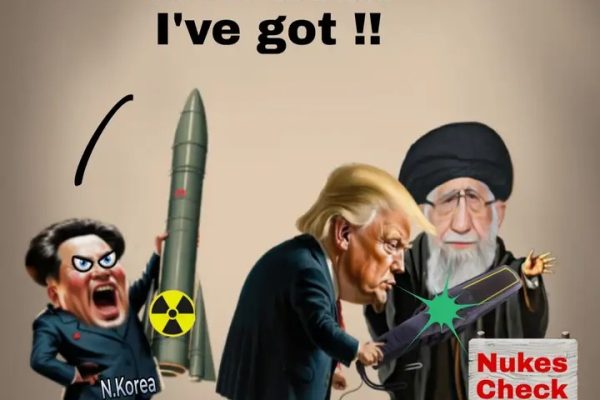
During the third and final televised presidential debate on May 27, People Power Party candidate Kim Moon-soo said, “If it were possible to acquire nuclear weapons within the bounds of that alliance, we ought to do that.” The argument that South Korea needs its own nuclear weapons to deter the nuclear arsenal of North Korea is based on the idea that only nukes can deter nukes.
The belief that only nukes can deter nukes is based on the Cold War logic of mutually assured destruction, or MAD. This logic is based on the scenario that if the enemy can launch nukes at me to turn my country into ashes, I can do the same to him, and we all go down. This logic expects the “balance of terror” to deter both sides from actually pressing that red button.
Those who argue for South Korea to go nuclear say that no matter how sophisticated our conventional weaponry is, they are insufficient for deterring a nuclear strike. During celebrations of Armed Forces Day on Oct. 1 of last year, South Korea unveiled its Hyunmoo-5 missile, which has an 8-ton warhead. It was judged to be a “monster missile” that is among the world’s most powerful surface-to-surface missiles. The advocates for nuclear armament, however, argue that the destructive power of the Hyunmoo-5 is a thousand times less than a strategic nuclear weapon and is therefore incomparable. They are concerned that without nuclear weapons, South Korea will be effectively defenseless, just asking to be attacked.
When it comes to nuclear weapons, the strategy of MAD is well known in South Korea. But there is another, lesser-known, strategy of “damage limitation.” During the Cold War, Western and Soviet strategists predominantly fell into two camps, MAD and damage limitation, and engaged in fierce debate.
A pillar in the logic of MAD is deterrence through nuclear retaliation against the enemy’s large cities with dense civilian populations. In 1960, US Secretary of Defense Robert McNamara argued that if the US could achieve a level of MAD that would annihilate 20% of the Soviet population and 50% of Soviet industrial capacity, there would no longer be any need for nuclear weapons. McNamara and those who agreed with him opted for urban strikes that would result in the mass murder of civilians over precision strikes against military facilities because, after being hit with an initial strike, the enemy would still need to possess the capacity for retaliation in order for the balance of terror to operate as intended. Thus, the MAD faction arrived at the strange conclusion that urban strikes and the mass slaughter of civilians served as the basis for peace and stability.
The logic of MAD, and its accompanying mass slaughter of civilians, was criticized as being inhumane and immoral. The opposite camp came up with the theory of limited warfare, or damage limitation, which calls for the renunciation of the desire for total victory and for the pursuit of a limited set of objectives. The limited warfare advocates argued that if nuclear war is unavoidable, then the war should be conducted as logically as possible, which means avoiding urban targets and concentrating on military targets instead.
When applied to the Korean Peninsula, the divide between the MAD and damage limitation camps becomes clear in one’s attitude toward the Hyunmoo-5. The MAD camp points out that while the Hyunmoo-5 is among the top conventional warheads, it cannot stand up to the destructive power of a nuclear weapon. In the event of an armed conflict, unless you launch thousands of conventional missiles simultaneously, you cannot level Pyongyang the way a nuclear missile could, they argue.
The argument stems from the logic that only the capacity to level Pyongyang and cause mass civilian casualties can properly deter the North Korean nuclear threat.
Deterrence is the prevention of threatening behavior by explicitly communicating to the enemy that threatening behavior will be met with a greater threat that would incur major costs to the enemy.
The most effective tool in deterrence is military capacity, but the key element of deterrence is the fear of awakening a sleeping lion. Deterrence is not destructive power itself, but a high-level psychological game that gets the opponent to abandon the idea of attacking out of fear that the attack will unleash a retaliation at scale. The argument that only the capacity to turn Pyongyang into ashes can deter North Korea’s nuclear threat views deterrence as only destructive capacity.
The strategy of MAD as defined by Western thinkers is based on the presumption that the enemy will not rush to use its nuclear weapons, primarily out of fear that its capital will be destroyed and that it will suffer massive casualties. There is no guarantee that North Korea shares this logic. The North Korean regime’s primary concern is its own survival and continuation. Even if a nuclear strike destroyed Pyongyang, the regime would remain mostly unaffected if the strike did not inflict major damage to the regime’s leadership.
Based on this peculiarity of the North Korean regime, there is no need to destroy Pyongyang. The North Korean regime’s calculations of whether or not to use nuclear weapons would be affected by South Korea’s capacity to send 100 to 200 Hyunmoo-5 missiles in a series of precision strikes that would destroy North Korea’s military and war leadership.
Park Jong-seung, former director of the Agency for Defense Development, recently submitted a column to the media outlet Firenze’s Dining Table, in which he argued that it’s possible to maintain a “balance of non-nuclear terror” based on the capacity of cutting-edge conventional weapons.
He argued that if South Korea can conduct precision strikes against the enemy’s top leadership and military bases using multiple missiles armed with powerful conventional warheads, we could achieve the same effect as possessing nuclear missiles. Strategic deterrence that involves a kill chain that puts surveillance, resolution, and strikes all under one roof, combined with advanced massive retaliation that would take out enemy leadership, is the most realistic strategic solution that non-nuclear states can adopt.
We need to take apart the basic assumption that we can only fight nukes with nukes, which has been taken for granted.
© 2025 front-page.com.ng