



By Grace Izilien
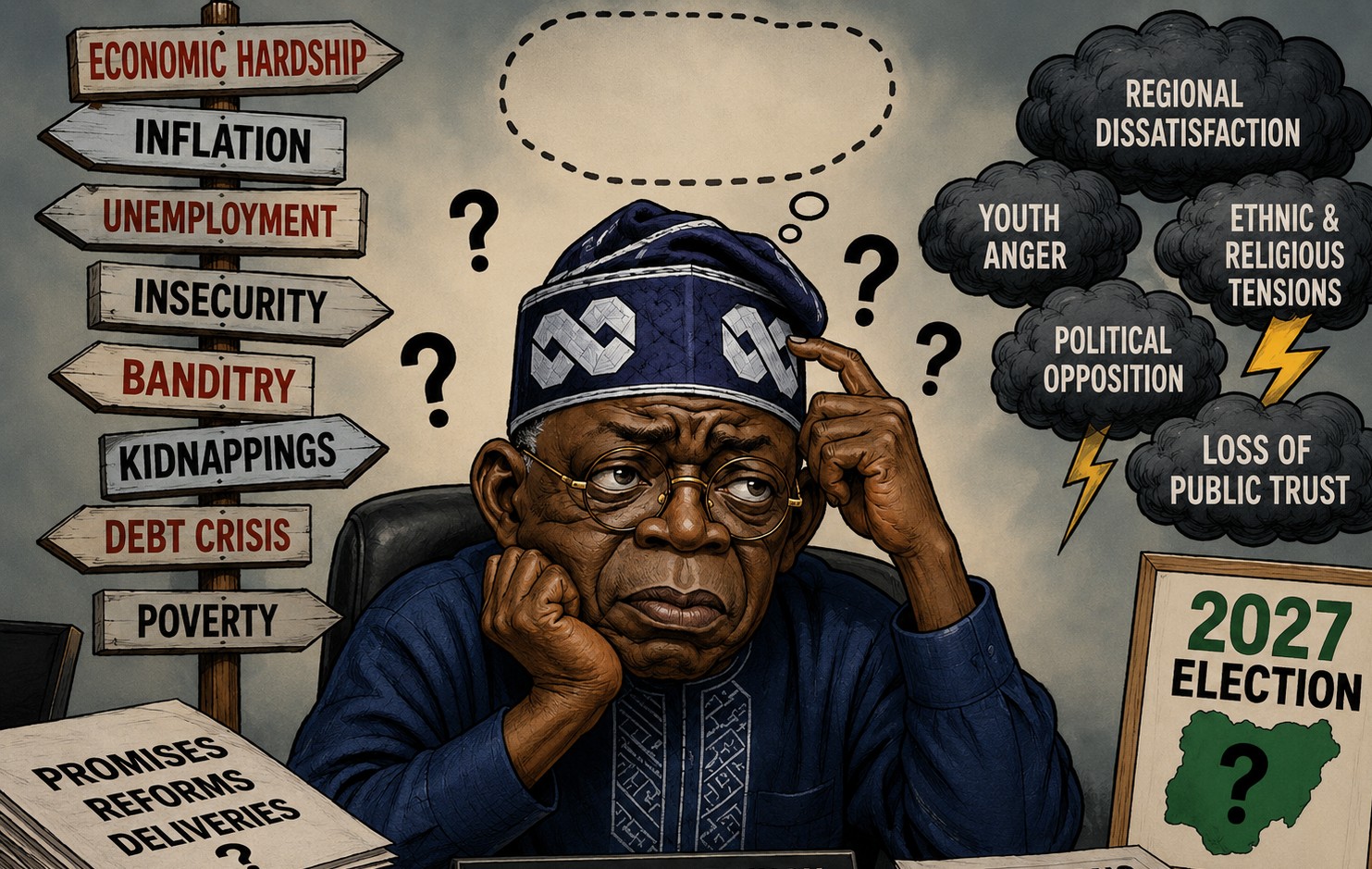
In a politically complex country like Nigeria where elections are rarely decided on ideology or principles, economic hardship, regional discontent, insecurity and political fragmentation look certain to feature prominently as 2027 election high-tension campaigns draw closer. Those issues and realities may determine whether President Tinubu secures another mandate in 2027 presidential election – or faces a national demand for political change.
President Bola Ahmed Tinubu assumed office in May 2023 amid enormous expectations from Nigerians who hoped his administration would address the country’s longstanding economic difficulties, insecurity, unemployment, infrastructure decay, and governance challenges. As self acclaimed “political strategist” and one of the most influential figures in Nigeria’s democratic history, he assumed office with promises of citizens welfare, adequate security, youth employment, economic reform, national renewal, and institutional restructuring. However, three years into his first term, growing political uncertainty, economic hardship, regional grievances, insecurity, and public dissatisfaction have increasingly generated discussions about his chances of securing reelection in the 2027 presidential election.
Although Nigerian politics remains highly unpredictable and no electoral outcome can be determined months ahead of voting, many political observers and public affairs analysts believe the Tinubu administration faces serious political vulnerabilities that had weakened public support across several regions of the country. These concerns stem largely from worsening economic realities, rising cost of living, insecurity, political tensions, youth unemployment, bloated cost of governance, and patronage-based governance.
The biggest challenges confronting the Tinubu administration are the economy and insecurity. Shortly after assuming office, the president announced the sudden removal of fuel subsidy with the infamous “subsidy is gone” gaffe, a policy long recommended by economists and international financial institutions. While supporters of the decision argued that fuel subsidies were unsustainable and financially damaging to the Nigerian economy, the immediate social consequences were severe for ordinary citizens. Petrol prices rose sharply, transportation costs increased nationwide, food prices escalated rapidly, and inflation spread quickly across nearly every sector of the economy. Millions of Nigerians suddenly faced an avoidable increase in the cost of living, placing enormous pressure on households already struggling with poverty, insecurity and unemployment.
Fuel prices moved from around ₦185 – ₦220.00 per litre before the administration to over ₦1,300.00, and in some areas above ₦1,450.00 per litre. This increase affected nearly every sector of the economy. For example, transport fares from Lagos to Jos, which previously cost about ₦15,000.00, reportedly increased to between ₦35,000.00 and ₦42,000.00. Commercial transport operators transferred rising fuel and maintenance costs to vulnerable passengers, while businesses increased prices of goods and services to survive the economic pressure. Food inflation also worsened significantly. Basic food items became more expensive, making it difficult for many families to feed adequately. Many households reduced meal rations and frequency as purchasing power continued to decline. Critics argue that the middle class, which was already struggling before 2023, became severely weakened under the combined effects of inflation and rising living costs.
The administration’s foreign exchange reforms and the floating of the naira further intensified economic hardship. The depreciation of the naira increased import costs, weakened purchasing power, and created difficulties for businesses dependent on imported goods and raw materials. Traders, manufacturers, pharmaceutical companies, and middle-class families all experienced the consequences of rising inflation and currency instability. Importers complained that clearing a 40-foot container, which previously cost around ₦4 million, now attracts close to ₦10 million in some cases due to exchange-rate instability, customs duties, and logistics costs. Critics argue that while the reforms may have improved investor confidence and aligned Nigeria more closely with international financial expectations, ordinary citizens continue to suffer the immediate burden of these economic adjustments which had resulted to higher prices of goods across markets.
According to official data from the Debt Management Office Nigeria, president Tinubu’s administration has accumulated N74.6 trillion in new loans debt since taking office (2023-2026), in contrast to about N49.8 trillion loans Buhari took in his 8 years rule (2015-2023), even as Nigerians endure higher charges on basic commodities and services. In a clear case of abdication of constitutional responsibility, president Tinubu implemented an electricity tariff increase under the Band A–D classification system introduced in the power sector. Critics described the arrangement as “energy apartheid,” arguing that some areas received better electricity supply while many poorer communities continued to suffer blackouts despite paying higher tariffs, a breach of citizens constitutional rights to affordable and interrupted public infrastructure. Despite the government’s unconstitutional action, small businesses and manufacturers continue to face increased operating costs due to epileptic electricity and dependence on alternative energy sources.
Access to telecommunications equally became more expensive as poor service delivery persisted. Before the worsening inflation, ₦5,000 could purchase close to 40 gigabytes of internet data from some providers. However, rising operational costs and inflation reduced affordability for students, remote workers, online businesses, and digital entrepreneurs. For the education sector, parents and guardians continue to lament about increases in tuition fees in primary, secondary and tertiary institutions. Many Universities, colleges and boarding secondary schools increased tuition, hostel fees, feeding fees, and other charges, placing additional burdens on students and families. With more students dropping out of schools due to financial strain, the current concern of 15 – 18.3 million out-of-school children, according to recent data from the Nigerian Federal Ministry of Education and UNICEF would only get worse – creating a recruitment pool for growing insurgency and other forms of insecurity.
Banking and financial transaction charges have become a source of frustration for many Nigerians. Citizens complained about numerous deductions, transfer fees, maintenance charges, SMS fees, and digital transaction costs at a time when electronic banking had become essential for daily living. Many Nigerians therefore ask what tangible benefits citizens have received in return for the economic sacrifices demanded by government policies. Analysts argue that despite enduring inflation, unemployment, transportation increases, electricity hikes, and declining purchasing power, many citizens have received mainly ridiculous palliatives such as food distribution and cash transfers, which they believe are insufficient compared to the scale of hardship.
Youth unemployment and frustration present another major political risk for President Tinubu. Nigeria possesses one of the largest youth populations in the world, and many young people continue to struggle with unemployment, underemployment, and limited economic opportunities. Growing frustration among young Nigerians has increased political skepticism and strengthened online activism across social media platforms. Young Nigerians increasingly use social media not only for entertainment but also for political mobilization, protest coordination, and public criticism of government policies. Many youths view the political establishment as disconnected from their realities. If unemployment and economic difficulties persist, younger voters could become a powerful anti-incumbent force during the next election cycle.
Security challenges also remain a major national concern, with the kidnapping of 46 primary school pupils and teachers, including a two year old in Oriire local government, Oyo State being the latest. Independent security tracking organizations and human rights groups estimate that thousands of Nigerians have either been kidnapped or killed in violent attacks. According to Amnesty International data, at least 10,217 lives were violently lost in the first two years of president Tinubu’s administration, while the conflict data hub ACLED recorded 7,472 fatalities in the same timeframe. Other local organizations, like the ICIR, estimate the overall toll to be higher, with up to 17,000 to 18,000 killed. Although the government frequently highlights military operations and security achievements, many communities across Nigeria continue to report violent attacks, kidnappings, and instability. In northern Nigeria, states such as Zamfara, Katsina, Kaduna, Sokoto, and Niger frequently experience banditry and mass kidnappings. Despite years of military operations against Boko Haram and ISWAP, affected communities remain at the mercy of the terrorists, as demands for stronger protection, rehabilitation support, economic recovery, and better intelligence get louder. These security challenges have disrupted agriculture, displaced rural communities, and decimated local economies. Since northern Nigeria represents one of the country’s largest voting blocs, persistent insecurity in the region has become politically damaging for the government.
Opposition politicians, civil society organizations, and activists have criticised what they described as regional imbalance in appointments, political favoritism, corrupt inducement of judicial officers, weak institutional coordination, and lack of transparency in government decisions. They have also expressed concerns regarding the handling of peaceful protests, political trials, media persecutions, and suppression of dissenting voices and free speech. Whether fully accurate or exaggerated, such narratives have strongly influenced public opinion about Tinubu’s government, and could negatively affect Tinubu’s chances in the election. Another major criticism concerns the rising cost of governance despite worsening public hardship. Analysts point to long government convoys, expensive official travels, large estacode allowances, and increased political appointments as evidence that political leaders continue to live comfortably while citizens struggle economically, and are asked to sacrifice more. This contrast has generated anger and resentment across many parts of the country.
In Nigeria, regional and ethnic politics remain central to democratic structure, and perceptions of exclusion or imbalance can strongly influence electoral behavior. Some political figures and commentators in northern Nigeria,have argued that the region has been unfairly marginalised under the current administration. Concerns have been raised regarding alleged imbalance in appointments, insecurity, and educational decline. Northern political elites have historically played decisive roles in national elections, and any significant political division within the region could create electoral difficulties for President Tinubu.
Niger Delta and South-South region’s longstanding complaints about environmental degradation, oil pollution, unemployment, and underdevelopment continue to shape political conversations. Regional stakeholders argue that despite the region’s enormous contribution to Nigeria’s oil wealth, local communities continue to experience poverty and infrastructural neglect, warning that any renewed militancy or regional alienation could become politically costly for the administration.
In the South-East, insecurity has equally remained a source of concern. Sit-at-home has distruped businesses and academic activities, as armed violence continued to paralyse the economy and daily life. Many residents believe the federal government has not adequately addressed the deeper political tensions within the region. Among some South-East political groups and organizations, longstanding grievances surrounding marginalization and federal character representation remain unresolved. Critics in the region frequently point to underrepresentation in strategic appointments, infrastructure development, and the federal government’s high handedness of separatist agitations.
Within the South-West where President Tinubu retains significant political influence, economic hardship has generated growing criticism and protests among urban residents. Cities such as Lagos and Ibadan continue to experience rising transportation costs, rent increases, extortion by nonstate actors on businesses, multiple taxation, and declining purchasing power. Critics also argue that overbearing political patronage and centralized decision-making continue to dominate governance structures.
The possibility of opposition coalitions – no matter how badly fractured they seem, ahead of 2027 also represents a major concern for the ruling party. Nigerian political history has shown that stronger and united opposition alliances can easily create formidable electoral threats for incumbents. Analysts believe that if opposition parties successfully rally diverse political interests, youth frustration, labour movements disenchantment, and regional grievances into a broader national coalition, President Tinubu could face a frightening reelection battle.
Unlike previous decades, political resentment now spreads rapidly through digital platforms such as X, Facebook, TikTok, Instagram, and YouTube. Social media and digital activism are now Nigeria’s politicians nemesis. Economic hardship, insecurity, corruption allegations, and governance failures quickly become viral national conversations capable of influencing public opinion across urban and rural communities.
Despite these criticisms, supporters of President Tinubu strongly defend the administration’s policies. They argue that the president inherited severe economic and institutional problems that required difficult reforms. They maintain that subsidy removal was unavoidable, economic restructuring takes time, and long-term benefits will eventually emerge from the administration’s policies. They also point to ongoing infrastructure projects, fiscal reforms, and efforts to stabilize the economy. Furthermore, supporters emphasise that incumbency advantages, vast resources, party structures, political alliances, and federal influence remain powerful factors in Nigerian elections.
Nevertheless, many analysts believe that elections in Nigeria are often shaped less by economic theories and more by the everyday experiences of ordinary citizens. For millions of Nigerians, daily realities currently include inflation, unemployment, insecurity, housing deficit, multiple taxation, transportation costs, food shortages, and declining purchasing power. If those conditions do not improve substantially before 2027, growing public frustration could fuel a nationwide anti-incumbent movement. Also, the central question remains whether the economic pain they currently experience will eventually produce meaningful improvements in quality of life. That question is likely to remain central in Nigeria’s political discussions as the country moves toward the 2027 elections.
While it remains impossible to predict the outcome of Nigeria’s 2027 presidential election with certainty, President Bola Ahmed Tinubu faces a range of serious political, economic, and social challenges that could threaten his reelection prospects. Economic hardship, insecurity, regional grievances, youth frustration, and declining public trust have combined to create an increasingly difficult political environment for him. Ultimately, the president’s political future may depend on whether ordinary Nigerians begin to experience meaningful improvements in living conditions, security, employment opportunities, infrastructure delivery, and national inclusion before the next election cycle, in a democracy he has been widely accused of scheming to undermine.
© 2026 front-page.com.ng