



By Oshiomhole Inumah
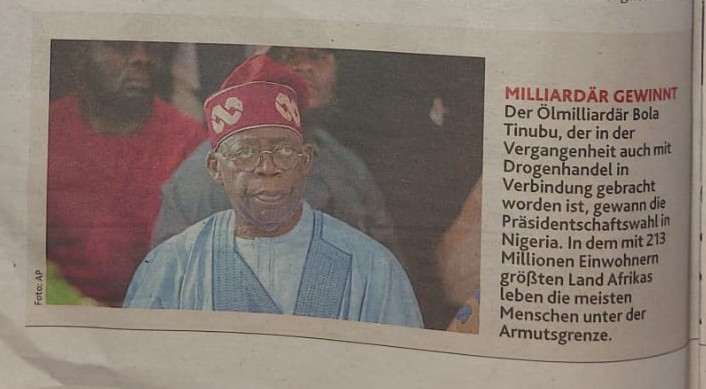
When an Austrian newspaper, Kleine Zeitung reported in March 2023 that Nigeria had elected “oil billionaire” Bola Ahmed Tinubu as president and added that he had been linked to drug trafficking in the past, the brief report appeared almost as a footnote to Nigeria’s historic presidential election. More than three years later, however, that seemingly small paragraph has acquired a new significance as a legal battle in Washington threatens to expose portions of historical U.S. government records concerning investigations involving Nigeria’s president.
The controversy is no longer simply about an Austrian newspaper, an old American court case or a political allegation repeated during Nigeria’s 2023 election. It has become a wider international question about transparency, presidential accountability, national reputation and whether the most powerful political office-holder in Africa’s most populous country should be subject to the same standard of scrutiny that democratic societies have applied to leaders elsewhere.
The Kleine Zeitung’s description requires precision. A fact-check by the Centre for Democracy and Development confirmed that the newspaper did report that Tinubu had been linked to drug trafficking in the past. But it did not describe him as a “drug lord” or “drug baron”, as some social-media claims subsequently alleged. That distinction is important. Tinubu has not been criminally convicted of drug trafficking in the United States, and responsible reporting should not transform a historical investigation or civil forfeiture into a criminal conviction that did not occur.
But it is equally misleading to suggest that the entire controversy is fabricated.
There was a genuine U.S. legal proceeding in 1993 involving funds held in accounts associated with Bola Tinubu. The American government pursued a civil forfeiture action, and $460,000 was ultimately forfeited to the United States. The court records are authentic, and the Associated Press and AFP have independently examined the historical documentation. AFP found that Tinubu was linked to the 1993 Chicago case involving drug trafficking and money laundering, but also stressed that the records did not show that he was indicted or convicted of drug trafficking.
That distinction, however, does not eliminate the questions surrounding the money.
The 1993 court decree ordered the forfeiture of $460,000 in an account held in Tinubu’s name. The court record stated that the funds represented proceeds of narcotics trafficking or were involved in financial transactions violating U.S. money-laundering statutes. The parties had reached a compromise settlement, and the money was forfeited rather than the matter proceeding to a criminal conviction against Tinubu.
The appropriate question, therefore, is not the simplistic one of whether Bola Tinubu was “convicted of drug trafficking”. He was not.
The more difficult question is what American investigators knew about the money, the people associated with the investigation, the accounts and Tinubu’s relationship, if any, to the wider investigation.
And that question is precisely why the American files still matter.
THE AMERICAN FILES THAT REFUSE TO DISAPPEAR
More than three decades after the original investigation, the matter has returned to the U.S. courts through a Freedom of Information Act lawsuit brought by American transparency advocate Aaron Greenspan.
The case, Aaron Greenspan v. Executive Office for U.S. Attorneys et al., Civil Action No. 1:23-cv-01816, concerns requests for records from several U.S. agencies, including the FBI and Drug Enforcement Administration. Among the requests is one seeking the entire FBI file concerning Bola Ahmed Tinubu and another seeking FBI Form 302 interview records involving Tinubu from 1992 and 1993. Form 302 documents are used by FBI agents to memorialise interviews conducted during investigations.
For years, the FBI and DEA responded to requests relating to Tinubu by invoking what is known as a Glomar response – effectively refusing to confirm or deny whether responsive records existed.
But that position suffered a major setback in April 2025.
U.S. District Judge Beryl Howell ruled that the FBI and DEA’s Glomar responses concerning Tinubu were improper and ordered the agencies to search for and process non-exempt records. The court concluded that the agencies had not sufficiently justified their refusal to acknowledge the records in the circumstances of the case. The CIA’s separate Glomar response was treated differently and upheld.
That ruling did not order every page of every file to be published without redaction.
American freedom-of-information law protects legitimate interests involving personal privacy, confidential sources, investigative methods and physical safety. Consequently, some material can lawfully remain secret.
But Judge Howell’s ruling established something important: the FBI and DEA could not simply use a blanket refusal to prevent the public from knowing whether records concerning Tinubu existed.
The legal battle therefore moved from “Do these records exist?” to the much more consequential question: “Which records can legally be released, and which parts may lawfully remain secret?”
TINUBU ENTERS THE AMERICAN COURTROOM
The case took an extraordinary turn in August 2026 when President Tinubu himself became formally involved in the American disclosure proceedings.
On August 19, reports from the litigation indicated that Tinubu had joined a request by the U.S. Department of Justice for additional time to respond to the court’s proceedings concerning disclosure. The Justice Department sought a 10-day extension, but Judge Howell granted a shorter extension and set an August 21 deadline.
The development deserves careful interpretation.
Tinubu’s participation does not establish that he is attempting to conceal evidence of criminal conduct. A person who is the subject of government investigative records has legitimate interests in protecting private information, confidential information involving other people and information that could expose investigative techniques or endanger individuals.
But politically, his intervention inevitably raises questions.
Why does a sitting president need to participate in litigation concerning the release of historical records relating to an investigation that has followed him for more than three decades?
If the records contain nothing damaging, would complete lawful disclosure not provide the president with an opportunity to finally settle one of the most persistent controversies surrounding his public life?
Those are legitimate questions, although they are not evidence of guilt.
The answer may ultimately lie in the records themselves.
THE FBI’S EXTRAORDINARY LATEST MOVE
The controversy deepened on August 20, 2026, when the FBI asked Judge Howell for permission to submit confidential declarations ex parte and in camera.
In practical terms, the FBI wants to explain privately to the judge why certain material should remain withheld, without putting the full explanation into the public court record.
The bureau says it is relying on several Freedom of Information Act exemptions, including provisions protecting personal privacy, confidential sources, investigative techniques and physical safety. It argues particularly that disclosure could reveal law-enforcement techniques or could reasonably be expected to endanger the life or physical safety of an individual.
The FBI’s request does not mean that the withheld material has been proven to contain evidence of criminal wrongdoing.
Nor does it establish that the person whose safety the FBI says could be endangered is Tinubu.
That distinction is essential.
Yet it is also understandable that the development has generated enormous public interest. The material being withheld concerns a historical investigation dating back to the early 1990s, and the current president of Nigeria is now participating in litigation over its disclosure.
The FBI has proposed submitting two confidential declarations to the judge. Reports on the latest filing say the bureau proposed an August 28 deadline for those submissions if its request is granted.
The public is therefore confronted with an unusual situation: a decades-old investigation, a sitting president, a federal transparency lawsuit and a U.S. intelligence and law-enforcement agency asking a judge to examine some of the justification for secrecy behind closed doors.
WHY ARE RECORDS FROM 1992 AND 1993 STILL SO SENSITIVE?
This is perhaps the most compelling question in the entire controversy.
The original investigation is more than 30 years old. Some investigative techniques used in the early 1990s may no longer be operationally sensitive.
If the withheld material identifies confidential sources who remain at risk, protecting their identities would be legitimate. If it exposes techniques still used by law-enforcement agencies, secrecy may also be justified. If it contains private information about innocent third parties, redaction may be necessary.
But where information is no longer legitimately sensitive, the public-interest argument for disclosure becomes stronger.
The principle should be straightforward: protect what the law requires to be protected, but release everything else.
That is essentially what Judge Howell’s 2025 decision requires the FBI and DEA to do: search for and process records that are not exempt from disclosure.
The question is therefore not whether every FBI document should automatically be thrown open to the public.
The question is whether the agencies are withholding more than the law permits.
That is precisely what the American court is being asked to determine.
IS THE TINUBU GOVERNMENT TRYING TO HIDE THE TRUTH?
This is where political interpretation becomes unavoidable.
Some Nigerian opposition voices and commentators have interpreted the president’s participation in the American litigation, the requests for additional time and the FBI’s continuing resistance to disclosure as evidence that the administration does not want the records to become public.
That accusation, however, should not be presented as an established fact.
There is presently no public evidence proving that Tinubu personally ordered the FBI to suppress records, nor is there evidence establishing that the withheld documents contain proof of criminal wrongdoing.
What is established is that Tinubu has intervened in the litigation, that the U.S. government is resisting full disclosure of some material and that the FBI is asking the court to consider parts of its justification privately.
The legitimate question is therefore not, “Has Tinubu been proved guilty?”
He has not.
The legitimate question is:
Why is there so much resistance to releasing whatever the law allows the public to see?
That question should be answered by the presidency, the FBI and ultimately the court.
Secrecy inevitably creates suspicion. Transparency can destroy suspicion — or confirm that some suspicion was justified.
Either outcome is preferable to an endless cycle of allegation and denial.
THE $460,000 QUESTION
The $460,000 remains one of the most important facts in the historical record.
The American government did not simply allege that money associated with Tinubu was connected to narcotics. A federal court ultimately ordered that $460,000 in an account held in his name be forfeited to the United States under federal statutes concerning narcotics proceeds and financial transactions.
But again, the legal distinction is crucial.
A civil forfeiture of money is not the same thing as a criminal conviction of the person whose name appeared on the account.
That is why the responsible formulation is that Tinubu was linked to a U.S. narcotics-related investigation and forfeiture proceeding involving $460,000, not that he was criminally convicted of trafficking heroin.
The unresolved question is what additional evidence exists in the FBI and DEA records.
The answer may never be completely known if portions of the records remain legally protected.
But the public has a legitimate interest in knowing as much as American law permits.
THE KLEINE ZEITUNG’s QUESTION
There is another uncomfortable question that refuses to disappear.
If Tinubu believes that the Austrian newspaper’s report was false, why has he not, years later, taken prominent legal action against the publication demanding a correction, apology or damages?
The question should be asked – but not turned into a presumption of guilt.
Not suing a newspaper does not prove that its report is true. Politicians may decline litigation for strategic, financial, jurisdictional or political reasons.
A defamation action in another country can also be complicated, particularly where the publication relied on authentic court records.
And in this case, the newspaper’s wording was relatively cautious: it reportedly said Tinubu had been linked to drug trafficking in the past, rather than claiming that he had been convicted of drug trafficking. The existence of the 1993 American proceeding makes it difficult to dismiss the entire subject as a fabrication.
Nevertheless, the question remains legitimate:
If the report was false, why has the Nigerian president not made a sustained international legal effort to force the newspaper to retract it?
And an equally important question should be directed at the presidency:
If the newspaper’s account was substantially accurate, why should Nigerians not be permitted to see the underlying American records that could establish precisely what happened?
Neither question proves wrongdoing.
Both are questions of accountability.
WHAT IS GOOD FOR THE GOOSE SHOULD BE GOOD FOR THE GANDER
The controversy becomes even more compelling when viewed against the experience of other democracies.
Powerful leaders have repeatedly discovered that public office does not permanently shield them from investigation, documentary disclosure or judicial scrutiny.
The most famous example is perhaps Richard Nixon.
During the Watergate scandal, President Nixon fought to keep his White House tapes from investigators, invoking executive privilege. The dispute ultimately reached the U.S. Supreme Court. In United States v. Nixon, the court unanimously rejected the president’s attempt to withhold the subpoenaed tapes from the special prosecutor. The ruling opened the way for the release of the famous “smoking gun” conversation and contributed directly to Nixon’s resignation on August 9, 1974.
The story did not end with Nixon’s resignation.
Congress passed legislation placing his presidential materials under government custody. The National Archives subsequently preserved and released large quantities of the records, subject to lawful redactions. In 2013, after decades of review and legal disputes, the final portion of Nixon’s White House tapes was released to the public.
The lesson was not that America hated Nixon.
The lesson was that the presidency could not be permitted to become a private hiding place for evidence concerning the exercise or abuse of public power.
France offers another example.
Former President Nicolas Sarkozy has faced repeated judicial scrutiny after leaving office. In 2024, France’s highest court upheld his corruption and influence-peddling conviction. Sarkozy maintained his innocence and pursued further legal avenues, but the country’s judicial institutions did not treat his former presidency as an obstacle to prosecution.
South Korea has gone even further in holding former presidents accountable. Former President Park Geun-hye was removed from office following a corruption scandal and subsequently faced imprisonment, although her case underwent several rounds of judicial review and appeal.
These examples do not mean every allegation against every leader should automatically lead to prosecution.
They demonstrate something more fundamental:
A country’s dignity is not destroyed when its institutions investigate powerful people. Its dignity can actually be strengthened when its institutions demonstrate that nobody is above the law.
That is the principle Nigerians are entitled to demand.
What is good for the goose should indeed be good for the gander.
Embracing the latest and best technology-driven communication gadgets, cars, houses, and general lifestyle isn’t enough for Nigeria. If American presidents can be compelled to surrender evidence, if French presidents can be convicted after leaving office and if South Korean presidents can be prosecuted, Nigeria should not be expected to create a lower standard for its own political elite.
BUT DOES DISCLOSURE DAMAGE NIGERIA?
This brings the debate directly to the recent intervention by retired Lieutenant General Tukur Yusuf Buratai, former Chief of Army Staff.
In a position paper titled “Nigeria First: A Case for Protecting National Sovereignty and Dignity – A Patriotic and Non-Partisan Perspective,” Buratai urged Nigerians to resist what he described as foreign interference and warned that the controversy could damage Nigeria’s international reputation, economic interests and sovereignty.
General Buratai’s argument deserves to be taken seriously.
He has argued that when international audiences read headlines about a Nigerian president being linked to drug allegations, many people outside Nigeria may not distinguish between the individual president and the country he represents.
He has warned that negative international publicity could affect perceptions of Nigerian citizens, businesses and institutions and could potentially have consequences for investment, tourism, diaspora relationships and international partnerships.
In one of the most striking formulations of his argument, Buratai said:
“We are not protecting Tinubu; we are protecting ourselves.”
He has also argued that Nigerians did not elect an American court or the FBI to determine the character of their president.
There is a legitimate patriotic argument here.
Nigeria’s reputation belongs to more than its politicians. Millions of Nigerians who have never been accused of wrongdoing should not be stereotyped because of allegations concerning a political leader.
But Buratai’s argument also raises a question that deserves an equally serious answer:
Has Nigeria’s international image not already been battered by problems far more concrete than an American transparency lawsuit?
HAS NIGERIA’S IMAGE NOT ALREADY BEEN BATTERED?
Nigeria’s international reputation has for decades been affected by corruption, insecurity, kidnapping, terrorism, fraud and governance controversies.
Transparency International’s 2025 Corruption Perceptions Index gives Nigeria a score of 26 out of 100, placing the country 142nd out of 182 countries. The organisation says Nigeria’s score did not improve from the previous year.
Security is another problem.
As of July 2026, Britain’s Foreign, Commonwealth and Development Office continued to advise against all travel to parts of Nigeria and against all but essential travel to other areas, citing terrorism, kidnapping, violent crime and intercommunal violence.
The warning is not merely an abstract international perception.
Kidnapping has become sufficiently widespread that foreign governments routinely issue security warnings to their citizens travelling to Nigeria. In August 2026, Reuters reported a mass-abduction incident in Niger State involving hundreds of people, although the precise number shown in circulating footage had not been independently verified.
Nigeria’s image problem, therefore, cannot honestly be said to have begun with the Tinubu FBI files.
It has been accumulating through years of corruption scandals, insecurity, economic hardship and institutional weaknesses.
This leads to an uncomfortable question for those who argue that disclosure itself will damage Nigeria:
What damages a country’s image more – the publication of an uncomfortable historical record followed by transparent accountability, or the perception that a country protects its powerful citizens from scrutiny?
There is no automatic answer.
But history suggests that nations often recover credibility by confronting embarrassing truths rather than hiding them.
THE WATERGATE LESSON
The American experience with a United States of America former president, Richard Nixon is especially relevant because it directly involved the argument that disclosure could harm the presidency and national institutions.
The Nixon tapes did not destroy the United States.
They became part of the historical record.
The United States did not collapse because its president was investigated. Its democratic institutions ultimately emerged from Watergate with an important precedent: presidential power has limits.
The National Archives still preserves the Watergate records and tapes, with material released subject to lawful exemptions and redactions.
That is the distinction Nigeria must confront.
Protecting Nigeria’s image does not necessarily mean protecting every Nigerian president from embarrassment.
Sometimes the strongest way to protect a country’s image is to demonstrate that its institutions – including its president – can withstand scrutiny.
SOVEREIGNTY VERSUS TRANSPARENCY
Buratai is correct about one fundamental point: an American court does not decide who should govern Nigeria.
Nigerians elected their president, and Nigerian courts subsequently upheld Tinubu’s victory after challenges by his principal opponents.
But the American court is not deciding Nigeria’s presidency.
It is deciding a narrower legal question under American law: what U.S. government records may be released and what information can legitimately remain exempt.
The distinction is critical.
A FOIA court is not a foreign government overthrowing Nigeria’s sovereignty.
It is an American court interpreting American transparency law.
Indeed, there is an irony in the argument that Nigeria’s sovereignty is threatened by a foreign transparency proceeding.
Nigeria itself has courts and laws designed to compel disclosure and investigate wrongdoing. The problem is not that foreign courts exist; the problem is whether Nigeria’s own institutions have demonstrated sufficient independence and strength to inspire confidence that politically sensitive matters will be investigated without fear or favour.
If Nigerian institutions had already conclusively resolved every question surrounding Tinubu’s American history, the present controversy might carry less political force.
Instead, it is an American court that is now deciding whether American records should be released.
That should concern Nigerians not because America is interfering in Nigeria, but because Nigeria’s own democratic institutions should ideally be strong enough that Nigerians do not have to depend on foreign courts to uncover facts about their leaders.
THE CHARACTER QUESTION
The issue eventually returns to the character of the person occupying Nigeria’s highest office.
Should a country of more than 200 million people be led by a president whose biography continues to generate international questions about wealth, political influence and an old American narcotics-related investigation?
There is no responsible democratic argument for automatically answering “no” merely because allegations exist.
Nor is there a responsible argument for saying that allegations should never be investigated because the subject is president.
A president is entitled to the presumption of innocence.
But the public is entitled to information.
Those two principles can coexist.
Legal eligibility and public confidence are also not identical.
A person can legally qualify for office while still facing legitimate questions about transparency and judgment.
Conversely, an allegation does not become true merely because it is repeated frequently.
The correct standard is evidence.
WHAT COULD A PRESIDENT DO?
Perhaps the most politically difficult question is what a president who is completely confident in his innocence should do.
He could say:
Release everything that American law permits to be released.
Such a position would not necessarily make every allegation disappear, but it would fundamentally change the argument.
Nigerians would no longer have to rely on rumours.
They could examine documents.
Journalists could report on evidence rather than speculation.
Historians could establish what happened.
And if the documents ultimately contain nothing incriminating, Tinubu would have an opportunity that few politicians receive: documentary vindication.
If the records contain embarrassing but non-criminal information, Nigerians would at least have the truth.
If they contain evidence of wrongdoing, the public would have a right to know that too.
Transparency therefore has the potential to serve Tinubu’s interests as much as those of his critics.
But the president does not control the FBI.
The American court decides what can be released. The FBI has legitimate statutory responsibilities concerning confidential sources, privacy, investigative methods and physical safety.
It would therefore be inaccurate to claim that Tinubu can simply order the FBI to publish its files.
The question is narrower:
Will Tinubu support the fullest lawful disclosure of records concerning him?
That is a question the presidency can answer.
THE 33-YEAR QUESTION
General Turkur Buratai has also urged Nigerians not to judge Tinubu solely by alleged events dating back 33 years. He argues that a person can change substantially over three decades and that the president’s subsequent public service should be considered.
There is merit in that argument.
A democratic society should not assume that a person is permanently defined by allegations from decades earlier.
But the passage of time cuts both ways.
Thirty-three years is also a reason to ask why legitimate records should remain unnecessarily secret.
If the investigation is so old that it has no bearing on present conduct, disclosure should arguably be easier, subject to genuine legal exemptions.
And if the records contain nothing significant, their publication could finally end the controversy.
Time should therefore not automatically be used as a reason for secrecy.
It can also be an argument for transparency.
WHAT NIGERIANS DESERVE
Nigerians deserve a standard that does not change according to who occupies the presidency.
If an ordinary citizen is investigated, questioned and subjected to scrutiny, the occupant of the highest political office should not automatically receive a blanket exemption from public questions.
If a former president of another democracy can be investigated, if presidential records can be subpoenaed, if former heads of government can be prosecuted and if official archives can eventually be opened, Nigeria should not demand a weaker standard for itself.
The principle is simple:
What is good for the goose is good for the gander.
That does not mean that every document must be released.
It means that secrecy must have a lawful justification.
If a document contains the identity of a confidential source, protect the source.
If it reveals an investigative technique that remains genuinely sensitive, protect the technique.
If it exposes the private information of an innocent third party, redact the information.
But if the material can legally be released without compromising legitimate interests, Nigerians deserve to see it.
SHOULD A COUNTRY FEAR ITS OWN HISTORY?
Nigeria’s international reputation should matter.
But national dignity should not be confused with protecting leaders from embarrassment.
A country becomes stronger when its institutions can confront difficult truths.
The United States did not lose its identity because Nixon was forced to surrender his tapes.
France did not cease to be France because a former president was convicted of corruption.
South Korea did not become weaker because a former president was prosecuted.
On the contrary, those episodes became evidence that institutions could act against powerful people.
Nigeria deserves the same opportunity.
The country’s reputation should be built not on the absence of embarrassing information, but on the presence of institutions strong enough to confront embarrassing information honestly.
If the FBI records ultimately exonerate Tinubu, release them.
If they contain information that is embarrassing but irrelevant to criminal conduct, explain and contextualise it.
If legitimate exemptions require redaction, let an independent court determine what must remain secret.
And if the records contain evidence of wrongdoing, Nigerians deserve to know and the appropriate institutions should act.
That is not foreign interference.
That is accountability.
THE LINGERING QUESTION
The Kleine Zeitung’s 2023 report was only a few paragraphs long.
It said that an oil billionaire, Bola Tinubu, had won Nigeria’s presidential election and noted his past links to drug trafficking.
Three years later, an American court is dealing with requests for historical FBI and DEA records concerning the very controversy that gave the newspaper’s report its most controversial sentence.
A 1993 civil forfeiture involving $460,000 is already part of the public documentary record. Tinubu was not criminally convicted of drug trafficking, but the existence of the forfeiture and the underlying U.S. investigation is not a social-media invention.
Judge Howell ruled in 2025 that the FBI and DEA could not maintain their earlier blanket Glomar responses and ordered them to process non-exempt records.
In August 2026, Tinubu joined a U.S. government request for additional time in the disclosure proceedings. The FBI subsequently asked the court to allow it to explain privately why some information should remain withheld, citing sensitive law-enforcement and safety considerations.
And now General Tukur Buratai has entered the debate, warning that disclosure could damage Nigeria’s international reputation and urging Nigerians to defend the nation’s sovereignty and dignity.
His warning deserves respect.
But it also deserves a response.
If Nigeria’s image is already suffering from corruption, insecurity, kidnapping, poverty and institutional weaknesses, why should Nigerians fear the truth about one historical investigation?
Could transparency actually improve the country’s reputation by demonstrating that Nigeria has nothing to hide?
Could a president who welcomes lawful disclosure emerge stronger than one who appears to resist it?
Could Nigeria’s reputation ultimately be damaged more by secrecy than by the facts themselves?
And if the records contain nothing capable of incriminating Tinubu, why should the presidency not enthusiastically welcome their release?
These questions cannot be answered by political loyalty.
They cannot be answered by calling every investigation “foreign interference”.
They cannot be answered by calling every critic an enemy of Nigeria.
And they cannot be answered by calling every allegation proof of guilt.
They can only be answered by evidence.
THE FINAL TEST
The ultimate test is not whether President Bola Ahmed Tinubu is liked or disliked.
It is not whether the allegations originated in Nigeria, Austria or the United States.
It is not even whether the release of the documents embarrasses the president.
The ultimate test is whether Nigeria believes in a principle bigger than any individual politician:
that public office is a position of trust, not a shield from legitimate scrutiny.
If the American court determines that portions of the records must legally remain secret, Nigerians should respect that decision.
If the court determines that records can lawfully be released, they should be released.
If the records vindicate Tinubu, Nigerians should accept that evidence.
If they raise new questions, those questions should be investigated.
And if they reveal criminal wrongdoing, the law should take its course regardless of the identity of the person involved.
That is how justice works in a democracy.
That is how institutions earn respect.
And that is how a nation protects its reputation – not by hiding every uncomfortable chapter of its history, but by demonstrating to the world that even when the truth is uncomfortable, Nigeria is strong enough to face it.
For Nigerians, the issue therefore goes far beyond Bola Tinubu.
It is about the kind of country they want to build.
A country where the powerful are protected from scrutiny?
Or a country where the powerful are subjected to the same law, the same evidence and the same demand for accountability as everyone else?
The answer should not depend on which political party is in power. It should not depend on whether the president is popular. It should not depend on whether an investigation began 33 years ago.
And it should not depend on whether the truth is flattering.
Because, in the end, what is good for the goose must also be fair to the gander.
© 2026 front-page.com.ng