




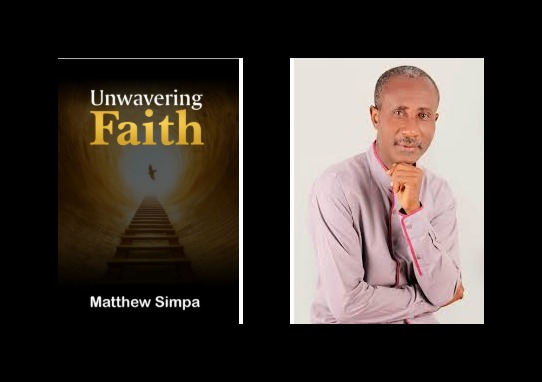
By Oshiomhole Inumah
The veteran Nigerian filmmaker, author and storyteller brings together more than four decades of organic creative experience in Unwavering Faith and River of Restoration, two works that reveal a continuing preoccupation with faith, family, hope, resilience, enduring human values and the power of the human spirit.
His remarkable journey from the pioneering days of reversal-film filmmaking to home-video production, television, literature and, most recently, music, is a story of resilience and reinvention. It is also the story of a man whose creative expression has continually evolved without abandoning the themes that have defined his work: faith, morality, family, struggle, hope and restoration.
Those themes converge compellingly in two of his recent creative works: Unwavering Faith, a 355-page novel published by Babcock University Press in 2024, and River of Restoration, a five-track Christian music project released under the name His Grace Voices.
Though one is a literary work and the other a musical project, they are united by a strikingly similar concern: what happens to faith when it is tested by life?
In Unwavering Faith, the test comes through family and generational change. In River of Restoration, it emerges through hope, mercy, perseverance and the revival of a dream that had remained dormant for almost four decades.
Together, they offer an illuminating portrait of a creative enigma with an unwavering spirit of conviction, endurance, faith, reinvention and creativity.
Life Before Nollywood
Born in Agege, Lagos, in 1964, Simpa began his formal journey into filmmaking with a certificate in Cinematography from the Nigerian College of Film, Owo, Ondo State, in 1984.
In 1986, he commenced his professional career with Meshfilms as an Assistant Film Director, entering an industry that was still searching for its identity and operating long before the term Nollywood was coined and became internationally recognised.
At Meshfilms, Simpa became involved in the pioneering experimentation with reversal film. He participated in productions including Lori-Ere, Ijagbemi, Gbegede Gbina and Iji Aye, gaining first-hand experience of an important but often under-represented chapter of Nigerian cinema.
His generation of filmmakers worked in an environment vastly different from today’s digital production landscape. Film production was more demanding, resources were limited and opportunities were considerably scarcer. Yet they were laying some of the enduring foundations upon which Nigeria’s later film industry – Nollywood – would be built.
Simpa’s career subsequently expanded into evangelical filmmaking, television production, video editing, screenwriting, directing and motion graphics. Between 1995 and 2000, he directed more than 20 films, contributing to the development of Christian and home-video productions.
Among his notable works was Valle de Baca, described in published accounts as the first successful home movie shot in the Benin Republic. His Osuwon Aye was also exhibited at the National Theatre in Lagos in the early 1990s.
His television work included the English-language soap opera The Burning Spear and the Yoruba-language Angeli Nigeria, while his professional association with Galaxy Television further broadened his experience in Nigeria’s evolving broadcast industry.
By the time the Nigerian home-video revolution exploded into popular consciousness, Simpa was already an experienced practitioner.
The Dream Before the Camera
But there was another creative ambition competing for Simpa’s attention.
In 1987, while still a young filmmaker, he walked into Japex Studio in Anthony Village, Lagos, determined to record music.
He paid for recording sessions and had renowned sound engineer Ed Jatto work on some of his tracks.
But the project did not become the album he had envisioned.
He subsequently wrote lyrics and sent them to the United States in the hope that they would be transformed into songs. That effort also failed to produce the desired results.
In 1988, he sang a duet with another artiste on the soundtrack of Jagunlabi, a film produced by Meshfilms Ltd.
Then the music receded into the background.
For decades.
The camera took over.
A Tested Career
The passage from young filmmaker to established creative professional was far from smooth.
Simpa has described his career as a rollercoaster marked by periods of achievement, setbacks and reinvention. Following a major setback in 1998, he moved to Abuja in 2000, where what was initially intended as a temporary stay became a difficult period of professional rebuilding.
He turned to video editing as a means of survival and gradually began reconstructing his career.
Another setback followed in 2005, prompting his return to Lagos in 2006.
Even when opportunities were scarce, he continued to work within the creative industry. By 2013, he recalled having only two jobs, both paying less than a living wage.
Yet he persisted.
In 2014 came Outside the Box, which he produced and directed.
The pattern of his career had become clear: whenever circumstances closed one door, Simpa searched for another legitimate creative entrance.
That resilience is important to understanding both Unwavering Faith and River of Restoration.
From Camera to Pen
Matthew Simpa eventually turned his storytelling abilities towards literature.
In 2021, he published From Reversal Filmmaking to God’s Bedroom and Back: Untold Story of the Nollywood Revolution, an insider’s account of his experiences in Nigerian cinema.
The book sought not merely to tell his own story but to preserve the memory of an era in Nigerian filmmaking that could easily be forgotten as the industry moved rapidly into the digital age.
His literary interests have extended into Christian writing, poetry, short stories, essays and fiction, with works including The Issachar: Principle Discernment for Our Time and Turn Your Valley of Baca to a Well.
It is against this background that Unwavering Faith becomes particularly significant.
When Faith Faces Challenges
Published by Babcock University Press in 2024, Unwavering Faith centres on Kunle and Bimbo, a Christian couple whose steadfast convictions are tested when their children begin to question and move away from the religious and moral principles that have shaped their upbringing.
At its heart is a universal question:
What happens when parents and children no longer believe in the same things?
Simpa explores the increasingly complicated relationship between inherited values and personal conviction.
Kunle and Bimbo have built their family around faith. Their children, however, are growing up in a world of rapidly changing social values, technology, global cultural influences, peer pressure and new ideas about morality and personal freedom.
The conflict consequently goes beyond religion.
It becomes a question of identity, parenting, love and family cohesion.
Can parents remain firm in their convictions without becoming controlling?
Can children challenge the beliefs of their parents without destroying family relationships?
And can a family remain united when its members no longer share the same worldview?
These questions give Unwavering Faith its contemporary relevance.
Faith Cannot Simply Be Inherited
One of the novel’s most compelling ideas is the distinction between inheriting a religion and developing a personal faith.
Children may inherit their parents’ religious traditions, attend the same church, learn the same prayers and grow up within the same moral framework.
But eventually, they must confront those beliefs for themselves.
That process can be frightening for parents.
A father or mother who has spent years raising a child according to certain principles may find it deeply unsettling to watch that child question those principles.
The resulting questions can be painful:
Where did we go wrong?
Did we teach our children or merely instruct them?
Should we become stricter?
Should we compromise?
Can we continue loving our children without approving every decision they make?
It is in these tensions that Simpa’s novel acquires its emotional power.
The parents are not simply trying to preserve their children’s faith.
They are also being forced to examine the meaning and strength of their own.
Conviction and Control
Perhaps one of the novel’s most important contemporary implications is the distinction between unwavering faith and unwavering control.
They are not necessarily the same thing.
A parent can remain deeply committed to a religious conviction without turning the family into a battleground.
Likewise, a child can question a parent’s beliefs without necessarily rejecting the parent.
This creates the possibility of a more nuanced understanding of family conflict – one in which love is not dependent upon complete agreement.
For a Nigerian society where religion remains deeply embedded in family and community life, this is an especially important conversation.
Younger Nigerians now live within a cultural environment vastly more interconnected than that experienced by previous generations. Social media, global entertainment, international education and digital communication expose them to ideas that may differ sharply from those of their parents.
The family consequently becomes a meeting point between tradition and modernity.
Unwavering Faith places that meeting point under the literary microscope.
From Family Faith to a Nation’s Hope
It is this same concern with faith that flows, in a different form, into Simpa’s music.
After almost four decades, the old musical dream returned.
The result is River of Restoration, a five-track Christian music project released under the name His Grace Voices.
The project comprises:
Come to the River of Life – 5:39
Crown of Mercy – 4:22
Nigeria Shall Be Called Sought After – 5:18
The King Reigns – 6:07
Yet I Will Rejoice – 6:26
Together, the five songs run for approximately 27 minutes.
The titles immediately reveal the spiritual architecture of the project: life, mercy, national destiny, divine sovereignty and perseverance.
The album’s central metaphor is restoration.
And there is something almost poetic about that choice of title when considered against the artist’s own history.
The River of Restoration
The opening song, Come to the River of Life, establishes the river as a metaphor for divine renewal.
A river flows.
It refreshes.
It carries life.
It suggests movement where there was stagnation.
For a man whose own musical ambition remained dormant for nearly four decades, the symbolism is difficult to miss.
The second track, Crown of Mercy, turns towards divine compassion, while The King Reigns affirms the sovereignty of God regardless of circumstances.
The closing Yet I Will Rejoice carries perhaps the strongest note of personal resilience. The word “yet” implies difficulty, but also a refusal to surrender hope.
And then comes Nigeria Shall Be Called Sought After, extending the album beyond personal devotion into a declaration about the nation’s future.
It represents a vision of Nigeria not merely as a country struggling with present difficulties, but as a nation whose destiny can still be transformed.
In that respect, the song connects Simpa’s personal message of restoration with a broader national aspiration.
40-Year-Old Dream Finds Its Voice
There is an extraordinary parallel between the title of the album and the story of its creator.
The young man who entered Japex Studio in 1987 with the ambition of making a record could not have known that nearly four decades would pass before the dream returned.
By then, he had become a filmmaker.
Then an author.
Then a chronicler of Nigerian cinema.
Then a Christian writer.
And eventually, the microphone called again.
The dream was not dead.
It was divinely hibernated.
It had simply been waiting for another season.
That makes River of Restoration more than a musical release.
It is a personal testimony of delayed fulfilment.
It is also a reminder that creativity does not necessarily have an expiry date.
Sometimes, life takes an artist away from one medium only to return that artist to it years later with a deeper understanding of what he wants to say.
Seen together, Unwavering Faith and River of Restoration reveal a remarkable consistency in Simpa’s work.
The medium changes, but the underlying questions remain.
In filmmaking, he tells stories through images.
In literature, he explores them through words.
In music, he expresses them through melody, rhythm and song.
But beneath all three is the same impulse: communication through storytelling.
Unwavering Faith asks whether faith can survive the pressures of generational change.
River of Restoration asks whether hope can survive adversity and whether what appears lost can be restored.
Both ultimately return to the same human proposition:
Do not give up.
A Creative Journey and Nigeria’s Own Transformation
There is another reason Simpa’s story is significant.
His career has unfolded alongside the transformation of Nigeria’s creative industry.
He experienced filmmaking in the reversal-film era.
He witnessed the emergence of home-video production.
He worked in television.
He adapted to digital filmmaking.
He became an author documenting the history of an industry he had experienced from within.
And now, he has entered the streaming era with a digital music release.
His journey therefore mirrors, in miniature, the transformation of Nigerian storytelling itself — from analogue film to digital platforms and from local distribution networks to global audiences.
It is a journey that crosses generations.
And it demonstrates that reinvention is not necessarily a departure from one’s past.
Sometimes, it is the most authentic continuation of it.
Beyond the Artist: The Larger Conversation
Ultimately, the significance of Simpa’s recent work lies not simply in the publication of a novel or the release of an album.
It lies in the conversations both works provoke.
Unwavering Faith asks families to confront the difficult reality that love may have to survive disagreement.
It challenges parents to distinguish conviction from control and encourages young people to distinguish questioning from rejection.
River of Restoration, meanwhile, speaks to the possibility of renewal – the idea that failure, delay and disappointment do not necessarily represent the end of a story.
Together, they create a portrait of an artist whose work has become increasingly reflective of his own journey.
The filmmaker who once worked with reversal film is now writing about faith.
The author who documented the evolution of Nollywood is now singing about restoration.
The young man whose music recordings disappeared in the 1980s has returned to the microphone decades later.
And perhaps that is the most compelling chapter of Matthew Simpa’s creative story.
Some dreams take time to find their moment.
Some change shape as life unfolds. Some stories require more than one medium to reveal their full meaning. And when a long-awaited dream finally manifests, we often discover that the years of waiting were not wasted – they were preparing us for the moment when we would be ready to fulfil it.
Apparently, they prepared the veteran polymath for the moment when he would finally have something deeper to say.
For Matthew Simpa, the journey from the camera to the pen and now to the microphone is therefore not a series of unrelated creative pursuits.
It is one continuous story.
A story about faith tested, dreams deferred, resilience discovered, creativity renewed and restoration finally experienced.
And in that story, the title of his latest musical work becomes almost autobiographical:
the river has begun to flow.
Oshiomhole Richard Inumah, Assistant General Secretary of the Guild of Public Affairs Analysts of Nigeria (GPAAN), writes from Abuja, FCT
© 2026 front-page.com.ng