



By Michael Isaac
On the morning of February 28, 2026, the Middle East woke up again to the brutal logic of the fait accompli. The State of Israel announced a preemptive offensive against Iran, and international press reports indicate close coordination with Washington, including ongoing American strikes. In the hours that followed, the Russian Foreign Ministry came forward with a harsh statement, condemning the attacks as an “armed aggression” and calling for an “immediate return” to a political-diplomatic solution, citing risks of humanitarian, economic, and even radiological catastrophe. The message is written with a rhetoric of great power, namely an appeal to the UN and the IAEA, invoking the norms of international law, denouncing “hegemonism”. However, it is precisely here that a big problem for the Tehran-Moscow axis is seen, namely that Russia roars but does not bite. And in relation to Iran, in the heart of the Middle East, this gap between words and deeds is starting to show more and more clearly that the tiger is, in fact, made of paper.
The Russian statement is constructed as a moral and legal indictment. Moscow deliberately dresses the event in the vocabulary of the international order, such as “sovereign state,” “violation of norms,” “non-proliferation,” “IAEA safeguards.” But we must look at the simple question that every statement avoids, namely, what comes next? What is Russia doing, concretely, for Iran?
On the day of air strikes on a strategic partner, Moscow’s immediate, officially confirmed, practical reaction is the suspension of flights to Iran and Israel, plus recommendations to avoid closed airspaces in the region. It is the reaction of a power that protects itself from the consequences, not of a power that can change the military dynamics on the ground. When the first reflex is to withdraw its civilian aircraft from the area, not to project its force or activate its levers, the image of being a guarantor of something becomes more of a PR label than a strategic reality.
If the support were real, it would look different. It would mean security commitments, massive deliveries of defensive capabilities, information sharing, deployments of systems, credible economic pressure or political costs that Moscow assumes for Tehran. Instead, even in previous episodes of escalation, the Kremlin has reduced support to the level of words and mediation. In June 2025, after the American strikes on the main Iranian nuclear sites, official Russian sources explicitly noted that the strategic cooperation treaty signed by Putin with Iran in January does not include a mutual defense clause, and spokesman Dmitry Peskov suggested that Russia’s simple offer to mediate is, in itself, a form of support. This phrase says it all, namely that when mediation is presented as the equivalent of support, it is actually acknowledged that military or coercive support does not exist. This is in fact the definition of a paper tiger, namely rhetoric of power, but without the tools or will to impose a cost on the adversary.
Moreover, the Russia-Iran relationship, often invoked as an anti-Western “axis”, is increasingly becoming a relationship of necessity for Tehran and opportunity for Moscow. Iran has been useful to Russia in Ukraine through transfers of drones and military know-how, and the European Union has explicitly linked sanctions to Iran’s military support for Russia’s war against Ukraine, as well as for armed groups in the Middle East and the Red Sea region.
But even this dependence has eroded over time, and a recent Carnegie analysis points out that Russia is already producing a modified version of Iranian drones domestically, reducing the need for Tehran and shifting the balance of power in Moscow’s favor. And Western intelligence sources point out a devastating detail for the myth of the Russian protector. Promised deliveries, such as the S-400 or Su-35 aircraft, have been delayed or have not materialized, precisely because Russia does not want to decisively tip the regional military balance in favor of Iran and damage its relations with other actors. This is not a NATO-type alliance, not even a war alliance, it is a bargain, with strict limits set by Moscow.
These limits come from Russia’s core strategy in the Middle East, more precisely balancing, not engagement. Russia cultivates pragmatic relations with Iran’s adversaries, such as Israel, Turkey, and key Arab states, in order to stay in the game regardless of the outcome of regional confrontations. This balancing may seem diplomatically skillful, but it makes it impossible to truly protect Iran when Israel or the US decide to strike. Because, the moment Moscow moves from words to actions, it would dynamite the very network of relationships that still maintains its importance in the region. And the paradox of the last year makes it even more visible. Official sources, quoted by the media, reported that Israel lobbied Washington for Russia to keep its bases in Syria as a counterbalancing factor against Turkey’s influence. When Israel comes to see the Russian military presence as a useful tool in its game with Ankara, Russia is no longer an arbitrator or a regional great power, it is in fact a pawn selectively used by others, depending on their interests.
In fact, the strongest evidence of Russia’s loss of influence comes from the place that has been, for years, the showcase of Moscow’s power, namely Syria. The 2015 intervention provided Russia with the perfect stage to demonstrate its strength, consolidate its bases and present itself as the guarantor of the survival of its allies. Today, after the fall of Bashar al-Assad at the end of 2024, the same presence is being negotiated, contested and conditioned. On social media, we have been able to watch symbolic images, including how former rebels now stand at the entrances to the Russian bases at Hmeimim and Tartus, escorting Russian convoys and ceremoniously granting them permission before they leave. When you need an escort to leave the base that you freely controlled a while ago, this is no longer a projection of power, but simply tolerance granted by the new masters of the land. The symbolism-filled world of Arab politics immediately confused who the new emir in the region was.
The collapse of the Assad regime has damaged Russia’s reputation as an ally capable of guaranteeing the survival of its partners, undermining its previous claim to be an absolute security guarantor. If you couldn’t save the regime you adopted as a strategic project in the eyes of the entire world, why would Iran think you could?
Under these conditions, Russian reactions to strikes on Iran inevitably become more of a message and public relations exercise than an instrument of power. It is true that such crises offer Moscow tactical advantages, such as diverting the attention of the international community from Ukraine, increased pressure on Western aid flows, effects on the energy market, translated into increased revenues, but also a chance to pose as a mediator. But a credible mediator normally has the capacity to deliver something to the parties, such as guarantees, incentives, constraints. Russia, on the other hand, mostly delivers fairy tales. And fairy tales, no matter how geopolitical, become thinner as the episodes in which Moscow condemns without being able to stop anything de facto accumulate.
Even on a regional diplomatic level, Moscow no longer has the magnetism it had when Syria was its trophy, its success story. In 2025, Putin announced the first Russian-Arab summit, scheduled for October, as a signal that Russia remains a pole of influence. Only, when the time came, the international press reported that the meeting had been postponed due to low interest and few confirmations from Arab leaders. Sure, there may be contextual explanations, such as other crises or other agendas, but foreign policy is also about who makes time for you. And the fact that a summit intended as a show of strength ends up being postponed because not enough guests show up is no accident. It is clear evidence of a rapidly declining influence.
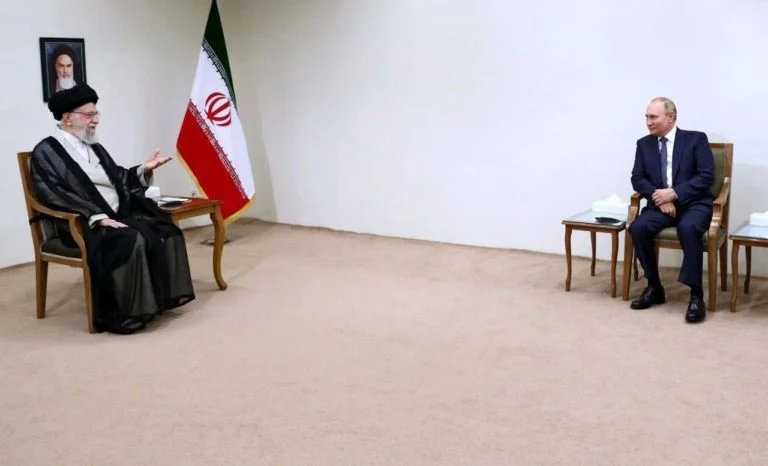
For Iran, the strategic conclusion is harsh but clear, namely that the Russian Federation is not a shield. It is, at most, a rhetorical umbrella and a useful partner in the gray areas of sanctions, dual technology, special services operations and discreet transactions. And in moments when the risk becomes existential, such as strikes on nuclear infrastructure, threats to the leadership, regional escalations, Moscow reflexively returns to the same repertoire and vocabulary, such as appeals to the UN, appeals to the IAEA, calls for negotiations, resounding condemnations.
There is nothing wrong with the appeal to diplomacy, per se. The problem is when diplomacy is used as a substitute for the lack of capacity to act. And that is what the elites in Tehran see. When promises of armaments are delayed, when there are no mutual defense clauses, when mediation is sold as support, the real message is that the Islamic Republic of Iran will ultimately be left to fight its own wars.
© 2026 front-page.com.ng